%20(1)_20220516165429_0.png&w=256&q=75&dpl=dpl_BY3MvZKRgduHvGnPbu36dAUCphUH)
5800 students unlocked their dream jobs with UG/PG programs in top colleges. Apply Now!
The way we learn is changing fast. While traditional education has shaped generations of graduates, today's employers are demanding more tangible talent with real skills, real experience, and real readiness for a fast-moving world. That's exactly where new age education steps in. But what's the actual difference, and which path is better suited for the jobs of 2030 and beyond? Let's break it down.
New Age Colleges vs Traditional Colleges
What Do New-Age Education Institutions Offer?
New-age education institutions focus on one main goal: helping students become job-ready for today's AI-driven world. Along with classroom learning, students work on real projects every semester, giving them practical experience and industry-relevant skills.
These institutions regularly update their curriculum to match changing industry needs, sometimes as often as every six months. Industry experts are actively involved in teaching, and students gain hands-on experience through internships and live projects.
They also focus on developing soft skills such as communication, personality development, teamwork, and interview preparation. As a result, students graduate with both technical knowledge and the confidence to succeed in the workplace.
What Do Traditional Colleges Offer?
With traditional colleges, they follow university-approved syllabuses and provide a stable academic environment with a strong focus on theory. While these colleges offer recognised degrees and academic credibility, practical learning opportunities can be limited.
Placement support and career guidance often vary from one institution to another, and many students need to manage their job search independently after graduation. As a result, some graduates enter the job market with strong academic knowledge but less hands-on experience than employers often expect today.
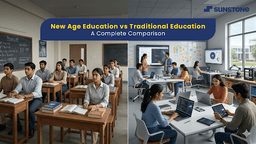
How Do Traditional Colleges Stack Up Against New Age Colleges?
Here's a side-by-side look at how modern learning environments compare to their traditional counterparts across the factors that matter most to students:
|
Parameter |
Traditional Education |
New Age Education |
|
Curriculum Updates |
Fixed, updated every few years |
Updated every 6 months with industry inputs |
|
Teaching Style |
Lecture-heavy, theory-first |
Hands-on, project-based, industry-driven |
|
Internships |
Optional or limited |
6–9 month internships built into the program |
|
Placement Support |
Basic campus recruitment |
1,200+ recruiters, 100% placement accountability |
|
Fee Model |
Upfront payment required |
Institutes affiliated with organisations like Sunstone can avail scholarship support, via merit-based financial aid, receiving up to 100% tuition fee coverage for undergraduate and postgraduate students |
|
Certifications |
Degree only |
Degree + up to 2 advanced industry certifications |
|
Soft Skills Training |
Minimal |
Dedicated sessions, personality & communication focus |
|
Mentorship |
Faculty-only guidance |
Industry experts, alumni network & career coaches |
|
Career Tracks |
Program Specific |
Students pursuing BBA can select from across 6 career tracks, including Business Development, Digital Marketing & Growth, and AI for Business. BTech and BCA students can opt from across 5 tech tracks: AI & ML, Full Stack Web Development, Data Science, Cyber Security, and AWS Cloud Computing. |
Can New Age Education Actually Make a Difference for Students?
Absolutely, and in more ways than one. Here's how industry-focused education translates into real advantages for students:
Skills That Employers Actually Want
One of the most relevant criticisms of traditional college courses is that graduates come out with textbook knowledge but struggle with real-world application. New age colleges solve this by working directly with industry leaders to design their curriculum. At institutions affiliated with Sunstone, the syllabus is reviewed and updated every six months based on recruiter feedback and market trends, so students are always learning what employers are actively hiring for, not what was relevant a decade ago.
Hands-On Learning Beyond Classroom Theory
New age programs incorporate practical learning throughout the degree, starting from daily coding practice and live projects to bootcamps, capstone projects, and a professional portfolio. Sunstone's B.Tech students, for instance, get 550+ hours of structured coding and DSA training, and graduate with a portfolio of real-world projects that speaks far louder than a grade sheet.
Flexible Learning Opportunities
Flexibility here means more than just timings. Future-ready education platforms offer students the ability to choose their own career track, pick from multiple specialisations, select advanced certifications relevant to their interests, and even opt into international immersion program. This kind of customisation allows students to shape a degree around their ambitions, rather than fitting their ambitions around a rigid degree.
Better Placement Opportunities
New age colleges maintain active, curated recruiter networks rather than relying on walk-in drives. Sunstone, for example, works with 1,200+ hiring partners, including Amazon, TCS, Infosys, IBM, PhonePe, and Axis Bank. Students receive structured interview preparations, including mock interviews, technical assessments, and coding rounds, before they ever face a real one. The result: better placements, at better companies, with better packages.
Personalised Mentorship
This is where the gap between old and new really shows. In a conventional college, mentorship often means an assigned faculty advisor you meet twice a semester. In new age institutions, it means access to industry professionals who actively build, lead, and hire in the real world. Sunstone connects students with 10+ domain experts across 30+ dedicated sessions, paired with career coaches who provide personalised guidance throughout the program.
What Do the Learning Outcomes Actually Look Like?
When you step back and compare graduates from both systems, the differences in outcomes are hard to ignore. A student completing a conventional B.Tech degree may have strong theoretical foundations but still find themselves struggling to demonstrate applied skills during technical interviews. Employers often report a mismatch between what candidates know and what the job actually demands.
In contrast, students from new age program arrive with a portfolio of real projects, 6–9 months of internship experience, advanced certifications, and a clear track record of working under industry-like pressure.
The numbers back this up, too. Sunstone's B.Tech students report an average package of 8 LPA for the top 20% of graduates, with the highest salary touching 26 LPA: outcomes that rival or outperform many conventional engineering colleges at a fraction of the total investment.
What Should You Consider Before Choosing Your College?
Choosing a college is one of the most significant decisions you'll make, and it deserves careful thought. Here are the key questions to ask:
- What are the actual placement outcomes, and are they independently verified?
- Does the curriculum reflect what the industry is hiring for today or five years ago?
- Is there a structured internship component, or is it left to students to find on their own?
- How is the fee structured, and does it put you at financial risk if placements don't come through?
- What kind of individual mentorship and career support is available?
- Can you choose your specialisation and career track, or is it one-size-fits-all?
If the answers to these questions matter to you, and they should, then the choice between new age vs traditional education becomes much clearer.
How Has Sunstone Become India's Top New Age Education Platform?
Sunstone reimagines education from the ground up. Operating across 20+ partner campuses pan-India, Sunstone has built a model where every element of the student experience is oriented around one outcome: a great job.
The program, spanning B.Tech, BBA, BCA, MBA, and MCA, are designed in close partnership with industry, updated regularly, and delivered by professionals who live and breathe the sectors they teach.
Our achievement reflects this too: Sunstone has been recognised as the Edtech Company of the Year, won the Best Placements Award, and been cited for Leading Innovation in AI-Powered Learning, making it one of the most decorated modern learning platforms in the country.
Final Thought
The debate between New Age vs Traditional Education isn't really about prestige; it's about outcomes. If your goal is a degree on a shelf, traditional colleges serve that purpose. But if your goal is a career that starts strong and grows faster, the future-ready education model that Sunstone has pioneered is built precisely for you. The world of work has changed; your education should too.
FAQ
Q1. What is the main difference between new age and traditional education?
New age education focuses on industry-aligned skills, internships, and guaranteed placements, while traditional education prioritises theoretical knowledge and grades without structured career outcomes.
Q2. Is new-age education better for getting a job after graduation?
Yes. New age colleges like Sunstone offer 1,200+ hiring partners, merit-based financial aid through their Bright Minds Scholarship Test, and structured placement prep, making career outcomes significantly more predictable than traditional program.
Q3. What makes Sunstone's model different from a conventional college?
Sunstone integrates an industry-updated curriculum, with B.Tech students receiving 6 to 9-month internships, expert mentorship, and its unique merit-based financial aid, ensuring students only get the best education for an established career ahead.
Q4. Can students pursuing traditional education switch to new-age learning?
Students can opt for Sunstone-powered program at the undergraduate or postgraduate level. Sunstone's partner campuses across India make industry-focused, outcome-driven education accessible nationwide.
Q5. What is the Bright Minds Scholarship Test (BMST) by Sunstone?
The Bright Minds Scholarship Test (BMST) is Sunstone’s merit-based scholarship exam designed for aspirants, admitted students, and droppers. Based on their performance, students can receive up to 100% tuition fee support for eligible B.Tech, BBA, BCA, and MBA program across 15+ Sunstone partner campuses, regardless of their admission status.
HELP
Take the first step towards your dream job.
ABOUT THE AUTHOR